
Oxford's Next-Generation RS3 Software Streamlines Discovery

Wide-ranging enhancements to industry-standard tools for integrating, managing and extracting chemical and biological data help speed research.
N/A (Hunt Valley, MD), which develops software for the life sciences, has introduced the next generation of the RS3 Discovery family of software for drug discovery research. RS3 Discovery is made up of the RS3 Discovery and RS3 Discovery HTS servers, as well as the RS3 Discovery for Excel client module. Enhancements to this widely used suite of software bring significant improvements in data handling in a number of key areas, including:
- New capabilities for storing and querying non-specific chemical structures
- Improved integration with drawing packages
- New molecular editing capabilities
- Improved ability for handling salts
- Improved loading and searching of catalogues, compounds, and products
Three Components
The RS3 Discovery server is designed to manage vast amounts of different types of data, integrate easily with existing systems, and improve communication among research team members. RS3 Discovery HTS server is used by organizations to handle the volumes of information produced by high-throughput screening operations Enhancements to the core RS3 Discovery server parallel those made to the RS3 Discovery HTS.
Among the improvements are new capabilities for storing and querying non-specific or Markush structures. RS3 Discovery for Excel lets scientists work in a familiar environment with high functionality. The new version streamlines searching, reporting, list and query management, and other core processes within a single application.
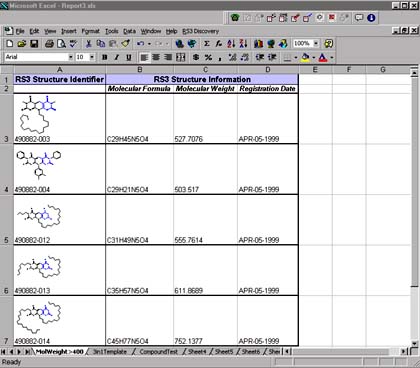
Enhancements made to RS3 Discovery for Excel Version 2.0 include the capability to query non-specific structures and the ability to conduct more complex queries.
"The typical life sciences organization faces a mountain of both legacy and newly generated data of all types," said Jeff Moore, vice president, Cheminformatics, Oxford Molecular Group. "We developed the original RS3 Discovery server to address this issue, assisting scientists in extracting greater value from chemical and biological data to achieve research goals more quickly."
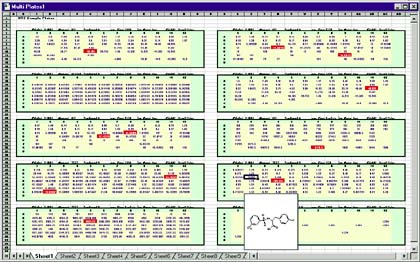
Combined with the RS3 Discovery module (pictured here), RS3 automatically imports biological assay data into a database.
RS3 Discovery is the first and only comprehensive discovery information management system built on the Oracle platform. "This new generation of the RS3 Discovery family boosts the overall capabilities of the system in a number of ways, and demonstrates our continued commitment to provide the software scientists need to speed the pace and improve the accuracy of their work," Moore added.
The RS3 Discovery product family offers a comprehensive software solution for pharmaceutical and biotech companies engaged in drug discovery research, as well as for others types of research in chemical-related industries. The system helps scientists more effectively handle the quantities of information generated by such research, allowing them to seamlessly integrate, manage and, most importantly, extract value from a wide array of chemical and biological data—even when that data is stored across disparate databases or systems. According to Oxford, it is the world's only commercial system for storing and managing the definitions of mixtures of chemical entities that make up complex substances, such as those used by companies specializing in cosmetics or fragrances.
For more information: Mary Herron, Oxford Molecular, 11350 McCormick Rd., Executive Plaza III, Suite 1100, Hunt Valley, MD 21030. Tel: 410-527-4538. Fax: 410-527-4599.